Single-cycle waveforms: what they are, and where to get free ones
What a single-cycle waveform is, why wavetable synths and samplers use them, how cycle length sets the pitch, and where to get thousands free, such as AKWF.
A single-cycle waveform is exactly one period of a sound wave, saved as a tiny audio file, usually a few hundred to a couple of thousand samples long. Played once, it lasts a hundredth of a second. Looped, it becomes a steady tone you can play at any pitch, which is why wavetable synths, samplers and trackers use them as oscillators. The best-known free collection is the Adventure Kid Waveforms (AKWF): over 4,000 of them, in the public domain.
This guide explains how they work, why the number of samples matters, where to find free ones, and how to make your own.
One cycle, looped, is a tone
Any steady pitched sound, a held organ note or a sustained synth pad, repeats the same shape over and over. Cut out one repetition, from one point to the matching point one period later, and you have a single cycle. Loop it and you get that sound’s timbre back, frozen: no attack, no decay, no change over time. Envelopes, filters and modulation in your synth or sampler bring the movement back.
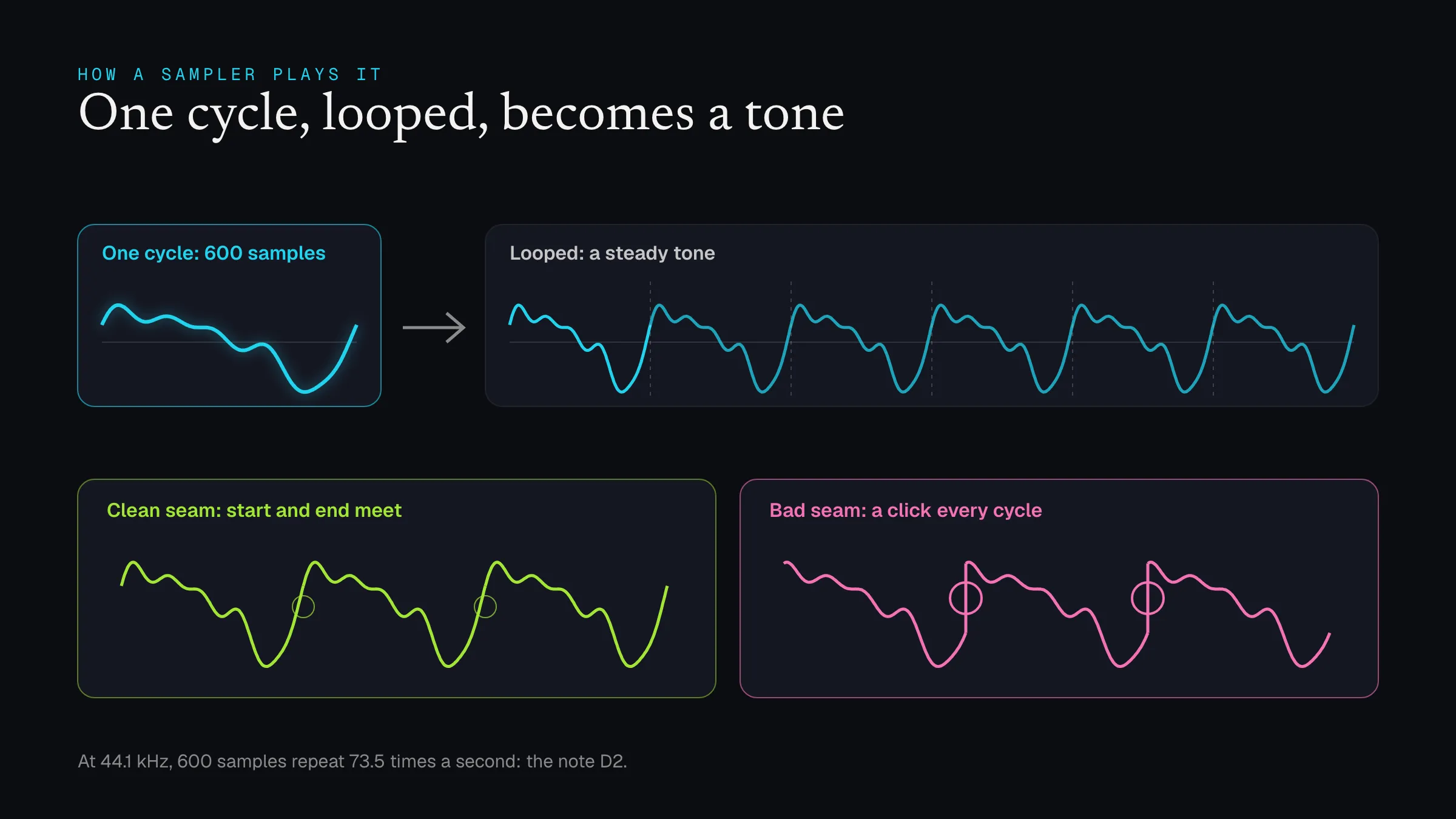 The seam matters. If the end doesn’t meet the start, every repetition clicks, 73 times a second for a low note, which you hear as a buzz.
Two things make a single cycle usable:
- A clean seam. The last sample has to lead smoothly into the first. A jump at the join is a click on every repetition.
- A known length. The number of samples in the cycle decides the pitch it plays at, so the sampler or synth has to know it.
The classic shapes
The oldest single cycles are the four waves of analogue synths. What makes them sound different is their harmonics: a set of sine waves at whole-number multiples of the note’s frequency.
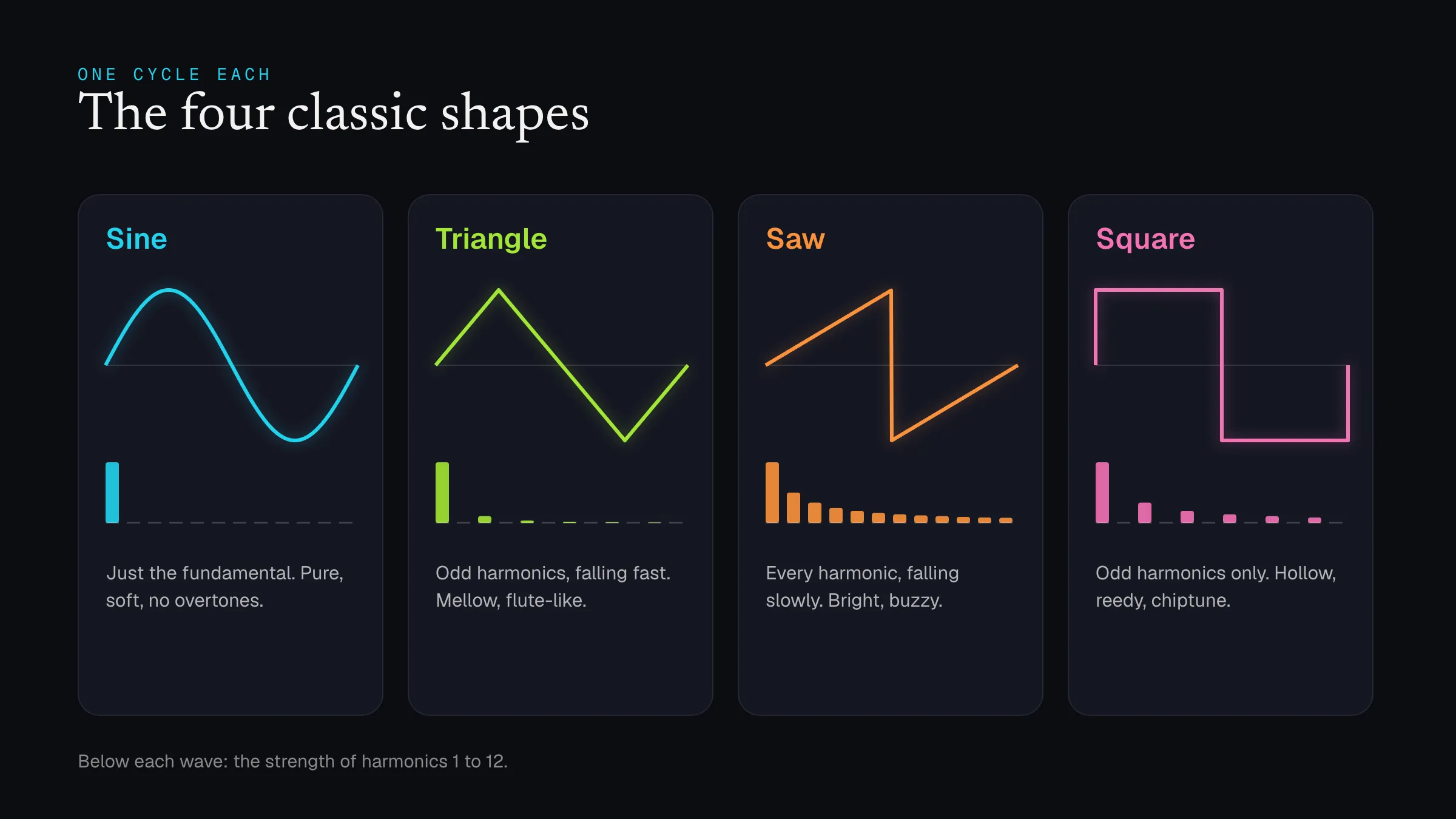 Same note, four shapes. The bars show how loud each harmonic is.
Everything else you find in a single-cycle library, from a sampled cello to a cycle pulled out of a Game Boy soundtrack, is just a different mix of those harmonics. That’s also why a single cycle of a real instrument sounds recognisable but static: you get the colour of the tone, not the bow or the breath.
Samples and pitch
A single cycle has no pitch of its own until something plays it at a sample rate. The rule is simple:
pitch in Hz = sample rate ÷ samples per cycle
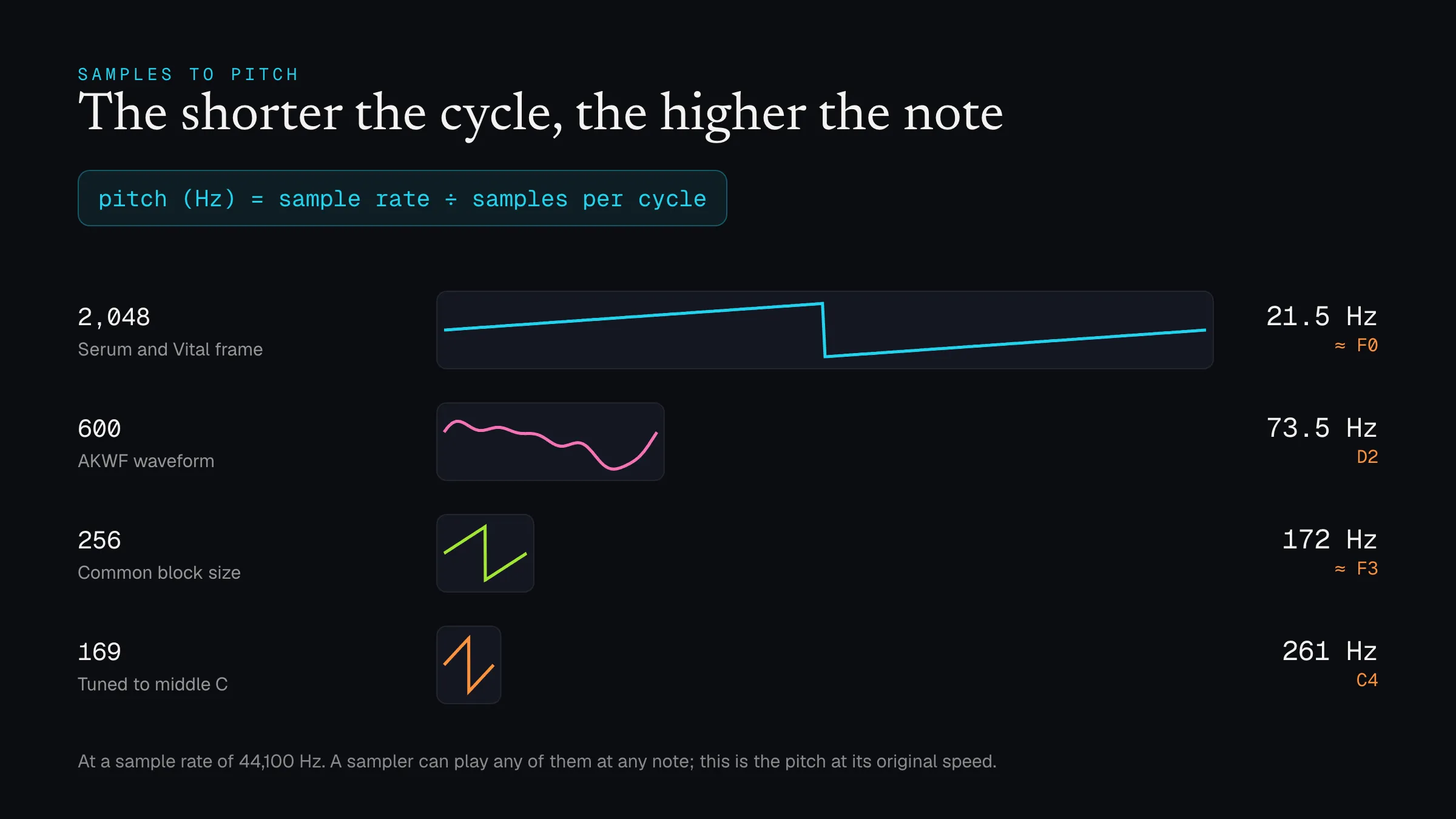 At 44.1 kHz. A sampler transposes from there, so what matters is that it knows the starting note.
That one formula explains most of the confusion around single cycles:
- Serum and Vital read a wavetable in frames of 2,048 samples. At 44.1 kHz a 2,048-sample frame would play at 21.5 Hz, but these synths don’t play the file at its own speed: they know each frame is one cycle and play it at whatever note you press.
- AKWF waves are 600 samples. At 44.1 kHz that is 73.5 Hz, the note D2 plus about two cents. Load one into a sampler that assumes the file is a C and everything plays two semitones sharp. Set the sample’s root note to D2 and it’s in tune.
- Samplers such as an Elektron Digitakt, an MPC or a Dirtywave M8 play a file at its recorded speed for its root note. So either you tell them the right root note, or you resample the cycle to the length that matches a root note: 169 samples for middle C.
- Powers of two (256, 512, 1,024, 2,048) are a habit from wavetable hardware and FFT maths, not a rule. Any length works if the player knows it.
A longer cycle isn’t higher quality in itself, but it can hold more harmonics before they fold back as aliasing, and it leaves the synth more room to play low notes cleanly.
Who uses single cycles
- Wavetable synths: a wavetable is a row of single cycles (frames), and the synth morphs between them. Serum, Vital, Arturia Pigments and Ableton Live’s Wavetable all import your own: drag a WAV onto the oscillator.
- Hardware samplers and grooveboxes: on a Digitakt, an MPC or an OP-1 a looped single cycle turns a drum machine into a basic synth voice. The Digitakt II comes with single cycles among its factory sounds, and its users trade packs.
- Trackers: the Dirtywave M8’s sampler loops part of a sample, so a single cycle plays as a sustained tone; trackers like Renoise and the classic Amiga ones were built on short looped samples from the start.
- Eurorack wavetable modules, such as those from Synthesis Technology, which made the free WaveEdit editor for theirs.
Where to get free single-cycle waveforms
Adventure Kid Waveforms (AKWF)
The AKWF collection by Kristoffer Ekstrand (Adventure Kid) is the standard free library: more than 4,300 single cycles, from basic shapes and bit-reduced chip waves to sampled guitars, flutes, organs, voices and violins. Every wave is a 600-sample, 44.1 kHz, 16-bit mono WAV.
It is released under CC0 1.0, which puts it in the public domain: you can use the waves in commercial music, sample packs and even your own instruments without asking or crediting, though the author appreciates a credit. Download the full ZIP from adventurekid.se, or get it from GitHub as AKWF-FREE. The page also links versions pre-formatted for several synths, such as u-he Zebra, Camel Audio Alchemy, Image-Line Harmor and Reaktor.
(Some older copies of the pack still mention a Creative Commons Attribution licence. The current one is CC0.)
Other good sources
- Your synth’s own content. Vital, Serum and Live’s Wavetable come with large factory tables; any frame of them is a single cycle.
- WaveEdit, the free, open-source editor from Synthesis Technology for Mac, Windows and Linux, comes with banks of wavetables you can edit and save as WAV.
- Make them. A recording of a sustained note, a synth you own, or a chiptune soundtrack all contain thousands of cycles. You need a tool that finds a clean one and saves it at the right length.
Making and batch-processing your own with Single Cycle Master
That last point is why we made Single Cycle Master, a free app for Mac and Windows. It has five tabs, one per way of getting a cycle:
- Single: open a WAV, AIFF, MP3 or OGG file and let Auto Block find the cleanest loop at a block size you pick (256 to 4,096 samples), or drag the selection by hand. Snap Start and Snap End move it to zero crossings, and a Loop Seam bar shows whether the join will click.
- Batch: a whole folder of samples in, one cycle per file out, all at the same block size and root note.
- VGM: open NES, Game Boy, SNES and other chip music files (NSF, NSFE, GBS, SPC, AY, HES), render a track and pull the real oscillator shapes out of it.
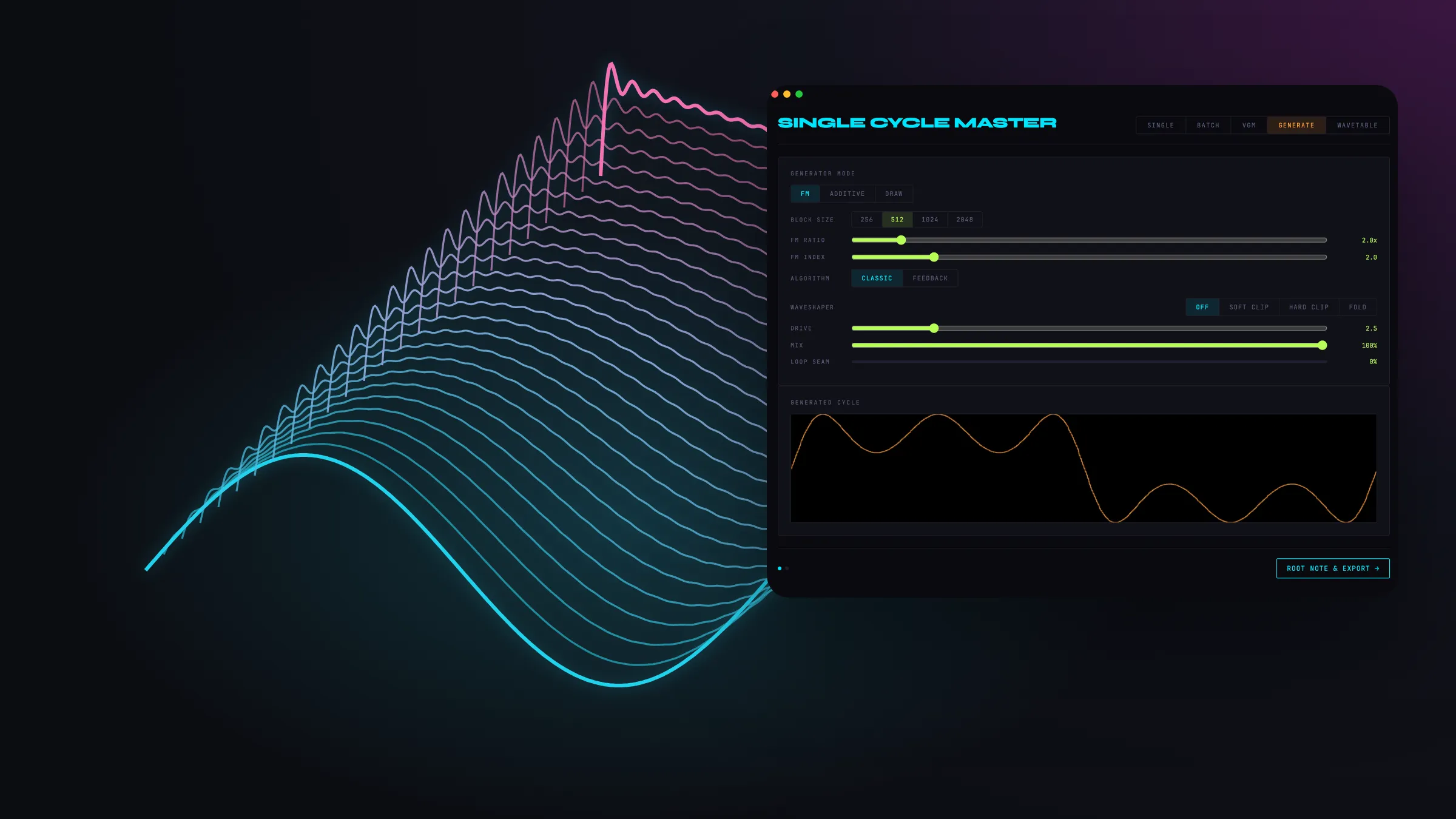
- Generate: make cycles from nothing with 2- and 4-operator FM, 16-partial additive synthesis or freehand drawing, then shape them with a waveshaper and a phase shaper.
- Wavetable: collect cycles from the other tabs as frames, reorder them, fill in the gaps by interpolation, listen with Play, Scan or Stack, and export.
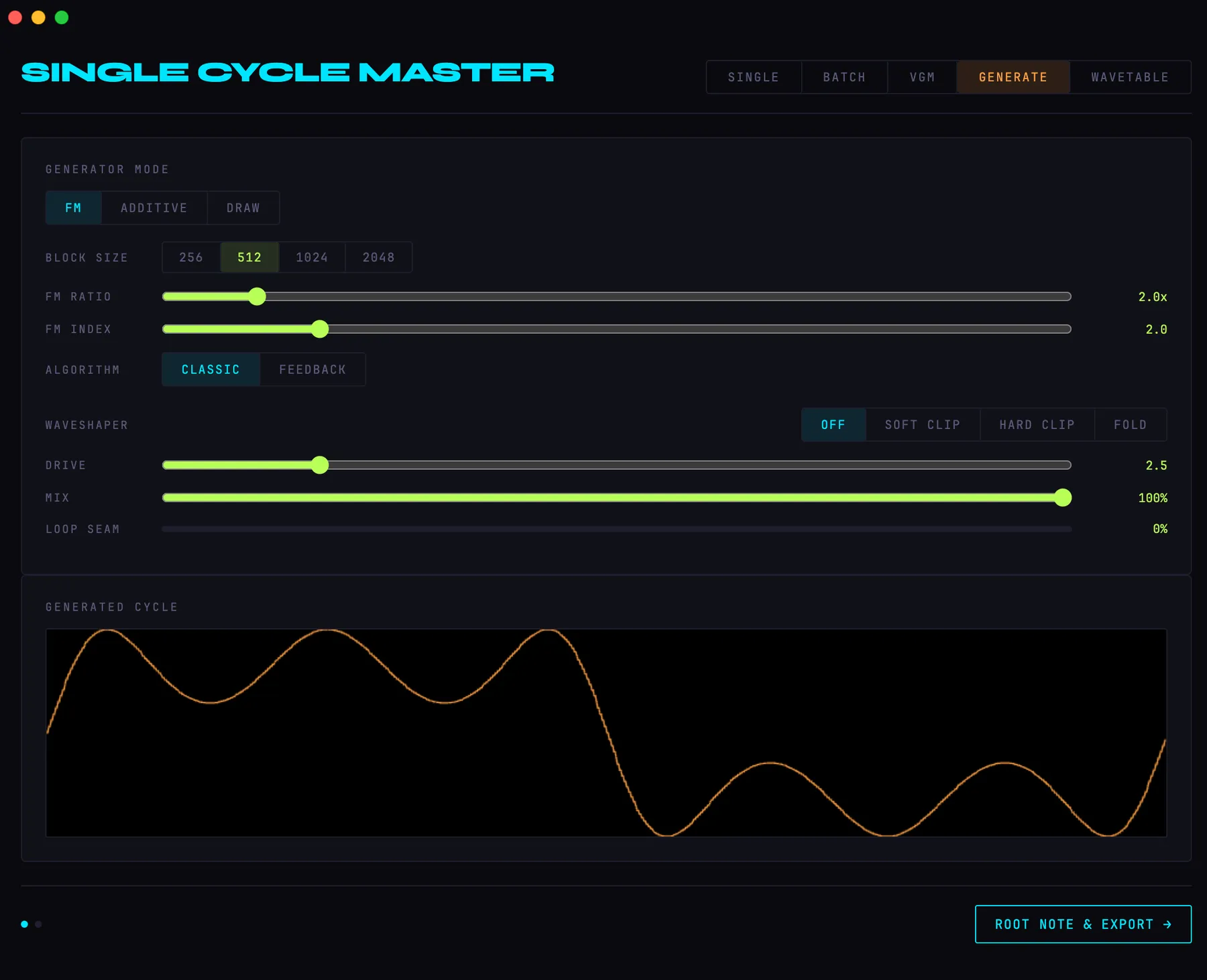 The Generate tab: FM, additive and drawn cycles, with a waveshaper after them.
Every tab ends on the same page: pick a root note on the piano, and Export Tuned WAV resamples the cycle to the length that plays that note at 44.1 kHz in a sampler, with the note and frequency in the file name, such as C4_261.6Hz_512smp.wav. Because a cycle can only have a whole number of samples, the tuning is within a few cents, not exact; for middle C, 169 samples comes out about 4.5 cents flat. Every export gets a short crossfade at its seam, so it loops without a click.
For Serum and Vital, the Wavetable tab exports all frames as one WAV; set Target Size to 2,048 first. Import WAV brings in existing files, so you can also load a few AKWF waves as frames, add your own between them, and export a table neither collection had.
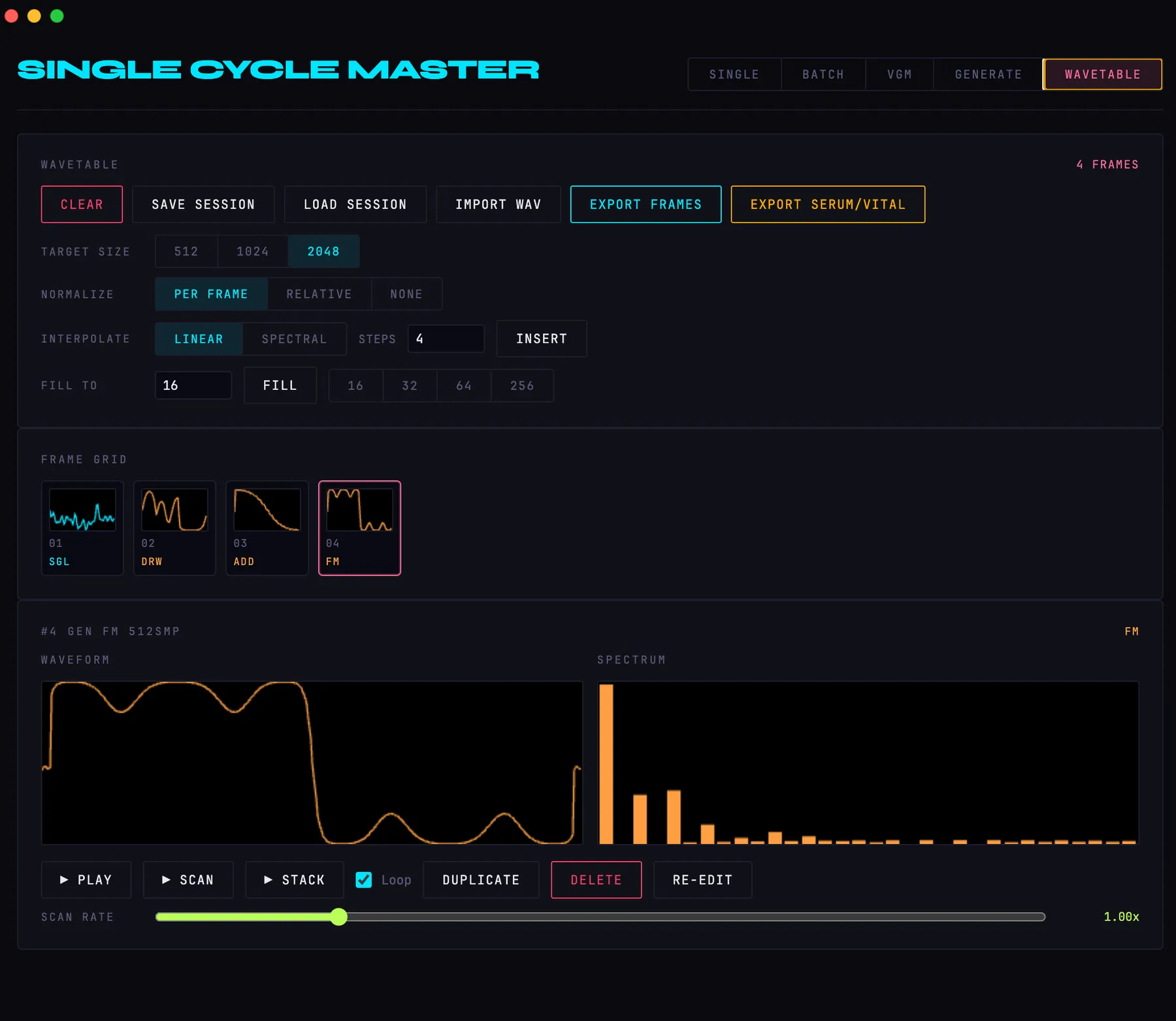 Four frames from four sources, ready to export as one Serum- or Vital-ready table.
Single Cycle Master runs offline. The download is free; you give an email address so the serial number can be sent to you, and it works for every update. The manual covers every tab.
Quick answers
Are single-cycle waveforms the same as wavetables? A wavetable is a set of single cycles meant to be morphed through. One single cycle is a wavetable with one frame.
Why does my single cycle play out of tune? The sampler doesn’t know its length. Set the root note to the one that matches (D2 for AKWF), or export it tuned to the root note your sampler uses.
Can I use AKWF in a commercial track or sample pack? Yes. CC0 means no permission or credit is required.
Single Cycle Master is one of several Monokern apps you pay for once, or not at all.